What a Solo Business Should Automate First
A month of actually removing work, in the order it happened. There is a way to decide what to touch first, and starting wrong wastes the momentum.
When people asked what they should automate with AI, I used to have no answer. I did not know either. After a month of doing it, an order has emerged. Here is what I actually removed, in the order I removed it.
How to choose
What matters more than what to automate is what to touch first. I filtered on three things.
One. Is there a correct answer? Work with exactly one right answer gets answered when you ask. Moving a website is like that. "What should my company say about itself" has no correct answer, so no amount of asking helps. I have to decide that.
Two. How much does being wrong hurt? Start where a mistake just means doing it again. Payments and personal data, where being wrong shakes the business, come later. I have not touched those.
Three. Does it come back every month? One-off work leaves nothing behind when automated. It has to recur to be worth building.
Start with whatever passes all three.
1. Cut a recurring cost
The first thing I did was move two long-neglected websites. About $400 a year went to zero.
There was a reason to start there. The result shows up as a number immediately. You see it on next month's card statement. Especially at the beginning, you need a visible result or you will not do the next thing.
It also passes all three filters. Correct answer exists, mistakes are recoverable, and the money went out every month.
2. Turn a full day into five minutes
Next was sending quotes. A request arrives, I check the exchange rate, apply per-product discounts, build the document, export a PDF, send the email. A full day.
It became five minutes. Not by buying software, but by using a feature inside the Google Workspace subscription I was already paying for. For years I had used it as an inbox and nothing else.
I suspect this is the most common situation. An unused capability sitting inside a tool you already pay for.
3. Make what you built openable by someone else
The third one is different. Nothing new was automated. I rebuilt something that already worked.
It worked fine, but nobody except the person who wrote it could open it. Changing a notification time meant opening code.
In a small company that is a real problem. An automation tied to one person stops when that person is busy and cannot be fixed when that person is gone. So now I hold two questions side by side: does it run, and does it run without me.
4. Catch the ones that stop quietly
After a few automations, a new worry appeared. Not knowing when one stops.
Work a person does gets noticed when it stops. Work handed to a machine does not. A job of mine meant to run every ten minutes ran seventeen times in a day and the dashboard was green the entire time.
So now, when I build an automation, I build the check with it. And it notifies me when things go right too. An alert that only arrives on failure cannot tell you the difference between nothing being wrong and the alerting itself being broken.
5. Put the numbers where you will look
Most recent. I made visitor and search data show up in my own admin screen instead of somebody else's dashboard.
The collecting still happens outside. A static site has no server, so there is nowhere of mine to record a visit. That part cannot change. But having to go somewhere to look can. A job pulls the data once a day and writes it to a file, and my screen reads the file.
If checking the numbers is a chore you stop checking, and if you stop checking you cannot fix anything.
The order again
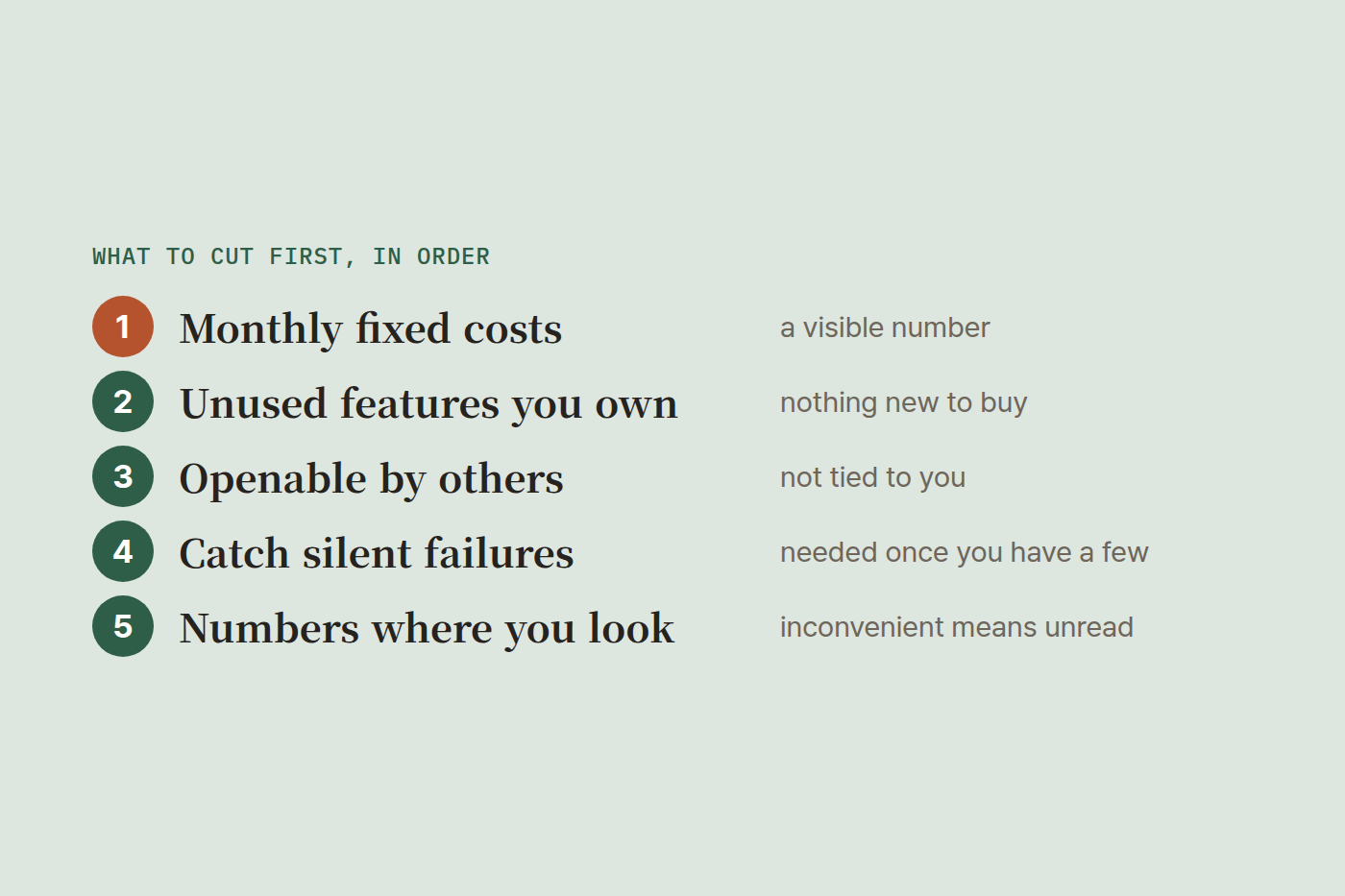
1  A cost that goes out monthly        the result is a visible number
2  Unused features in tools you own    nothing new to buy
3  Make it openable by others          do not tie it to yourself
4  Catch silent failures               required once you have a few
5  Put numbers where you look          inconvenient means unread
What I have not done
Payments and personal data are untouched. So is anything where being wrong means money is wrong, like bookings or inventory. Not because I cannot, but because I am not willing to own the failure.
I also do not ask AI what my company sells. Ask and you get a plausible sentence, but it is not about my company.
If you only pick one
Pick the first one. Look for something that leaves every month and is not being used. Website hosting, a forgotten subscription, a service you attached years ago. Reading one card statement top to bottom is a fine way to start.
Cutting one is enough to make you do the next one. That is how I started.