Which stage of AI fluency am I at? A 12-question check
Saying you use AI means different things to different people. Twelve yes-or-no questions place you on the five stages, with exactly one thing to do next at each stage. My own score is in here too.
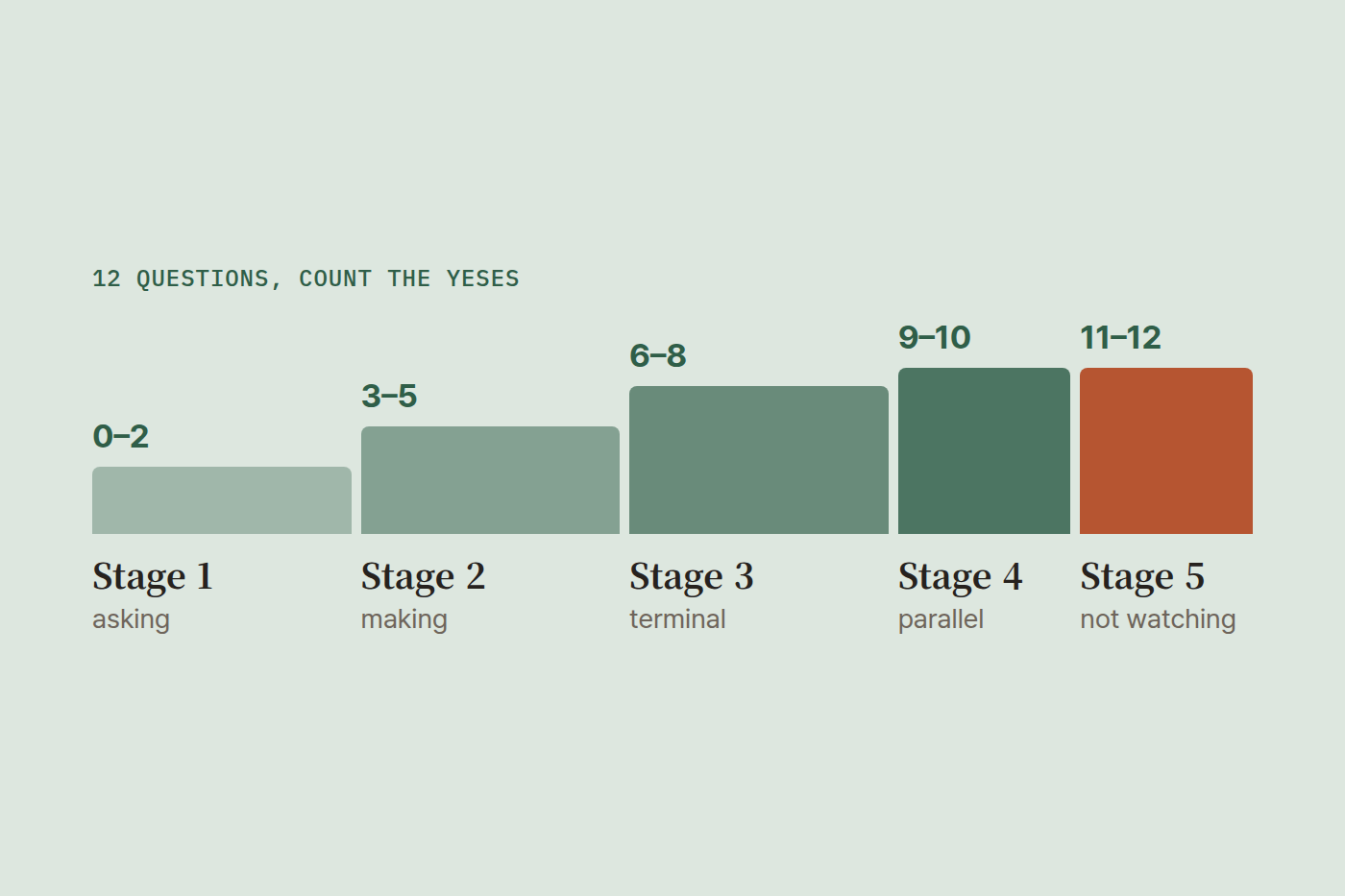
Plenty of people say they use AI. The phrase means different things. Someone who uses it instead of a search box and someone who hands it half a day's work say the same words. I wrote about five stages earlier, and readers asked which stage they were at. So here is a way to measure: twelve questions.
Answer yes or no and count the yeses. It only works if you answer honestly. Nobody is watching.
The twelve questions
Four about asking.
- When something comes up, I ask an AI before a search engine.
- After getting an answer, I have asked "why is that so".
- I have written a paragraph about my situation before asking, a question rather than a search term.
- I have restated what I understood in my own words and had it checked.
Four about making.
- I have made at least one thing with AI that I actually use: a document, a table, code.
- When I ask for a change, I can say where and how.
- I have automated a repeating task with AI, and it is still running.
- I have caught the AI being wrong inside a conversation.
Four about delegating.
- I have given an AI work from a terminal rather than an IDE or a chat window.
- I have run two or more AI sessions at the same time.
- I have received results without watching the AI work.
- I have the AI record what it did, and read that record first next time.
Score and stage
Map the yes count onto the five stages like this.
| Yes | Stage | What it looks like |
|---|---|---|
| 0 to 2 | Stage 1, asking | Search made easier. One question, then close the tab |
| 3 to 5 | Stage 2, making | Things start to come out. Changing them is still awkward |
| 6 to 8 | Stage 3, terminal | Out of the chat window. One or two automations running |
| 9 to 10 | Stage 4, parallel | Several sessions working. You are the bottleneck |
| 11 to 12 | Stage 5, not watching | Only results and records. More than half the work has moved over |
The boundaries are rough. Some people say no to 9 and yes to 12. The stages are a direction, not a sequence.
One thing for the next stage
Pick exactly one thing per stage. Try ten and none happen.
Stage 1: question 2. Add "why is that so" after every answer, the first of the seven questions. That alone turns a chat into a dialogue.
Stage 2: question 6. Read what you made one file at a time by asking and you will be able to say what to change.
Stage 3: question 7. Pick one weekly task, automate it, and check that it actually runs. Built and running are different things.
Stage 4: question 12. More sessions means memory becomes the problem. Making them record opens the next stage.
Stage 5: revisit question 8. The less you watch, the more you need questions that catch a wrong answer.
My own score
Counting while writing this, eleven of twelve were yes. The no is question 11. More results arrive without me watching, but I still watch. A month ago question 10 would have been the no; I was running a single session then.
One more yes per month is plenty. Put the recount date in your calendar. If the number has not moved, choose one item from the list above for that month.